Selamat Datang!

A warm welcome to the family blog of Hj Awg Omar and Hjh Aminah.

This is a place to capture all the memorable family moments to be shared with all the family members, wherever they are.

It is also a place to reminisce the good ole days :-)

All members of the family are welcome to contribute stories and pictures to this blog (just leave your email on the tagboard).


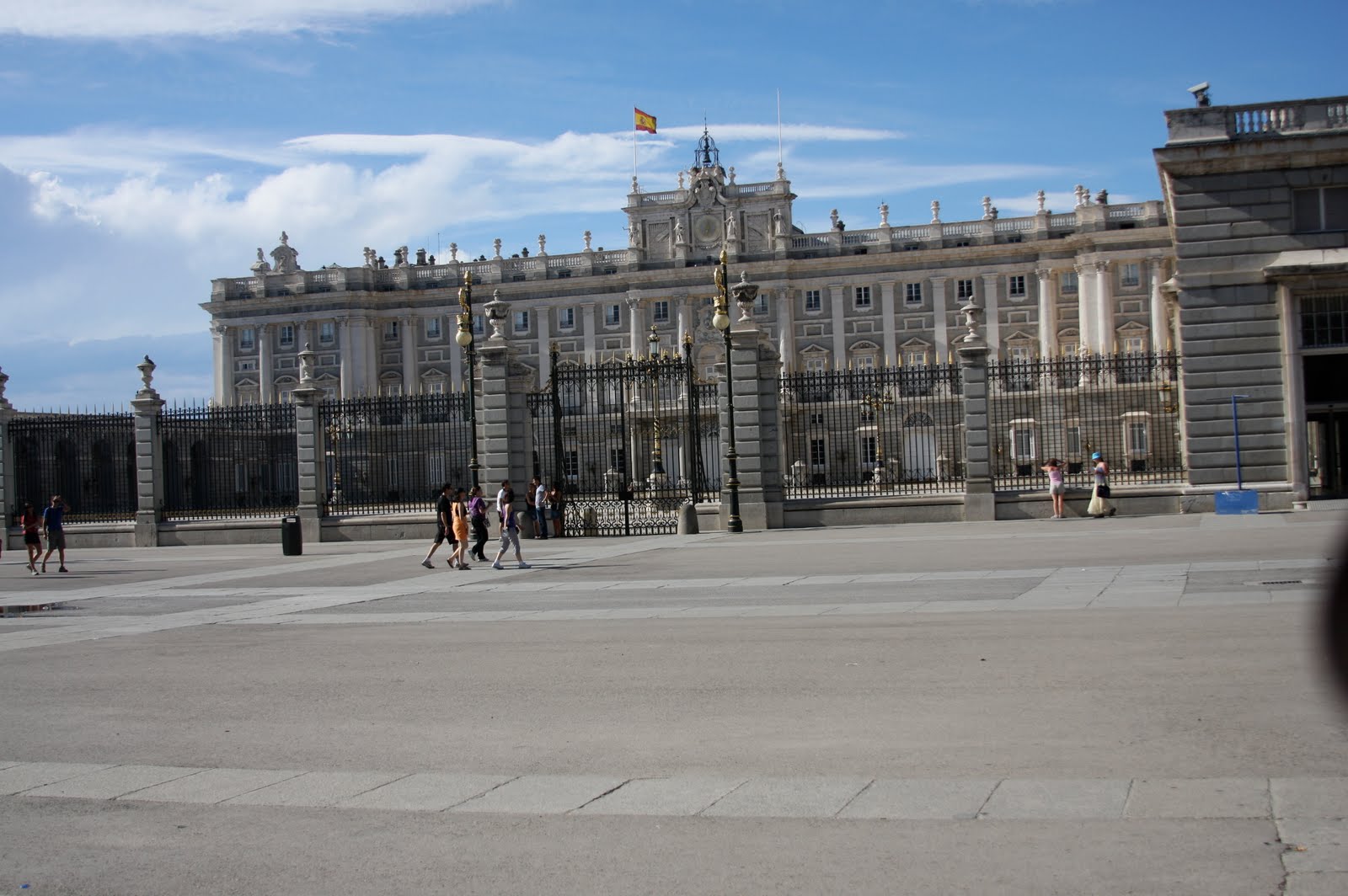
Menikmati keindahan Istana Diraja Real (Palacio Real)

Sesudah berada di Stadium Bernabeu selama hampir dua jam, kami beredar pulang ke apartment di Lavapies untuk menyimpan bag (luggage) yang Bibeh bawa bersama penerbangan dari London dan kami berehat sejenak sambil menikmati sajian makanan tengahari dengan masakan mee MAGGI!

Di sebelah petang kami meneruskan pengembaraan kami dengan berjalan kaki dari apartment di Calle de Lavapies dan menyelusuri lorong-lorong di sekitar jalan utama Calle del Sacramento menuju ke kawasan yang menempatkan bangunan bersejarah Istana Diraja Madrid (Palacio Real de Madrid) yang bergandingan dengan sebuah lagi bangunan yang indah dan penuh bersejarah iaitu Cathedral of the Almudena.


Tapak di mana bangunan Cathedral of Almudena ini didirikan adalah tapak asal yang pernah didirikan sebuah benteng atau Fortress yang dibina oleh Mohammed 1, seorang Amir dari Pemerintah Kerajaan Arab Kordoba dikurun ke-10.


Beginilah keindahan seni bina Istana Diraja Madrid (Palacio Real de Madrid) yang siap dibina pada tahun 1764.

Sedikit catatan mengenai Istana Diraja Real di Madrid:

The Royal Palace of Madrid, also known as the Palacio de Oriente (English: The Orient Palace, or Far East Palace), is the official residence of the King of Spain in the city of Madrid, and it is only used for State Ceremonies.

However, King Juan Carlos and the Royal Family do not reside in it, choosing instead the more modest Palacio de la Zarzuela on the outskirts of Madrid. The palace is owned by the Spanish State and administered by the Patrimonio Nacional, a public agency of the Ministry of the Presidency.

The palace is located on Bailén Street, in the Western part of downtown Madrid, East of the Manzanares River, and is accessible from the Ópera metro station. The palace is partially open to public, except when it is being used for official business.

History

The site of the palace dates from a 10th-century fortress, called mayrit, constructed as an outpost by Mohammed I, Emir of Córdoba and inherited after 1036 by the independent Moorish Taifa of Toledo. After Madrid fell to Alfonso VI of Castile in 1085, the edifice was only rarely used by the kings of Castile. In 1329, King Alfonso XI of Castile convoked the cortes of Madrid for the first time. Philip II moved his court to Madrid in 1561.

The Antiguo Alcázar ("Old Castle") was built on the location in the 16th century. It burned on December 24, 1734; King Philip V ordered a new palace built on the same location. Construction spanned the years 1738 to 1755[1] and followed a Berniniesque design by Filippo Juvarra and Giovanni Battista Tiepolo in cooperation with Ventura Rodríguez, Francesco Sabatini, and Martín Sarmiento. The new palace, directly facing the cathedral across the Plaza de Armas, was occupied by Charles III in 1764.

[edit]Interior

The interior that is open to visitors consists of:

  • the main staircase
  • Halberdiers Room
  • Hall of Columns
  • Throne Room
  • Saleta and antechamber of Charles III
  • Chamber and bedroom of Charles III
  • Gala Dining Room
  • Music Room
  • China collection
  • Royal Chapel
Throne room
The Royal Armoury (La Real Armería) museum
  • the imperial ballroom
  • the imperial bedchamber
  • 252 royal guest bedchambers
  • the diplomatic foreeea'
  • two grand maid's rooms
  • the blue porcelain room
  • the green porcelain room
  • the red reception room

[edit]Today


The vast palace is richly decorated by artists such as Velázquez, Tiepolo, Mengs, Gasparini, Juan de Flandes, Caravaggio, and Goya. Several royal collections of great historical importance are kept at the palace, including the Royal Armoury and weapons dating back to the 13th century, and the world's only complete Stradivarius string quintet, as well as collections of tapestry, porcelain, furniture, and other objects of great historical importance.

Below the palace, to the west, are the gardens of the Campo del Moro that were given this name due to the fact that here in the year 1109, Muslim leader Ali ibn Yusuf, encamped with his men in the attempt to recapture Madrid and its Alcázar (fortress) from the Christians. The east façade of the palace gives onto the Plaza de Orienteand the Teatro Real opera house. To the south is a vast square, the Plaza de la Armas, surrounded by narrow wings of the palace, and to the south of that is located theCatedral de la Almudena. To the north are the Jardines de Sabatini (Sabatini Gardens), named after one of the architects of the palace.

On the Plaza de Armas facade, two life-size statues on both sides of the main entrance honor the two native Emperors from the Americas, Moctezuma, Emperor of the Aztecs, and Atahualpa, Emperor of the Incas.

The wedding banquet of Prince Felipe and Letizia Ortiz took place on 22 May 2004 at the central courtyard of the Palace.

The palace is open to the public and it is closed when used by the king for state functions like state banquets for visiting heads of state, official government receptions and the presentation of new ambassadors to the king.


Salam hormat - Puda

Hari Kedua di Madrid


Stesen metro Tirso de Molina berhampiran dengan apartment di Calle de Lavapies

Hari ini (22hb Julai, 2010) Bibeh dijangka tiba di Madrid dengan menaiki pesawat Ryan Air dari Stanstead Airport, London kira-kira jam 12.40 tengah hari. Kami (Puda, Auntie, Zati dan Zayani) pun bergegas meninggalkan apartment di Lavapies menaiki metro dari Stesen Tirso de Molina menuju ke Lapangan Terbang Antarabangsa Barajas, Madrid untuk menyambut ketibaan Bibeh.

Perhentian pertama yang kami tuju setelah menjemput Bibeh dari Lapangan Terbang Barajas ialah Stadium Santiago Bernabeu, stadium pasukan bola sepak yang terkenal di Eropah, iaitu pasukan Real Madrid. Di sini kami sempat membeli beberapa helai baju bola pasukan Real Madrid dan juga baju bola pasukan kebangsaan Sepanyol.

Stadium Santiago Bernabeu - stadium bagi pasukan bolasepak Real Madrid


Sedikit catatan mengenai Stadium Santiago Bernabeu:

The Estadio Santiago Bernabéu (Spanish pronunciation: [esˈtaðjo sanˈtjaɣo βernaˈβeu]) is an all-seater football stadium in Madrid, Spain. It was inaugurated on 14 December 1947 and is owned by Real Madrid C.F. With a current capacity of 80,354 spectators, it was designated a UEFA Elite stadium in 2007.

El Bernabéu, re-named in honor of their former chairman Santiago Bernabéu Yeste, is one of the world's most famous and prestigious football venues.[citation needed]It has hosted the European Cup final on three occasions: in 1957, 1969 and 1980, and the UEFA Champions League 2010 final.[3] The finals for the 1964 European Nations' Cup and the 1982 World Cup have also been held at the Bernabéu.

Location

The Santiago Bernabéu is located on the Paseo de la Castellana, in the district of Chamartín. It occupies the block bounded by the Paseo de la Castellana and the streets of Concha Espina, Padre Damián, and Rafael Salgado.

[edit]History

On 22 June 1944, the Banco Mercantil e Industrial bank granted a credit to Santiago Bernabéu and Rafael Salgado for the purchase of the land adjacent to the oldChamartín Stadium. On 5 September 1944, architects Manuel Muñoz Monasterio and Luis Alemany Soler were hired and the structure on the site began to give way to the new stadium. On 27 October 1944, construction work on the stadium began.

The Nuevo Estadio Chamartín (English: New Chamartín Stadium) was inaugurated on 14 December 1947 with a match between Real Madrid FC and the Portugueseside Os Belenenses. The stadium had an initial capacity of 75,145 spectators, 27,645 of which had seats (7,125 covered) and 47,500 for standing fans. Sabino Barinaga was the first player to score in the new stadium.

[edit]The 1950s

The first major renovation occurred in 1954. On June 19 of that year the stadium expanded to accommodate 125,000 spectators. Thus, the Madrid coliseum became the biggest stadium of all the participants of the newly established European Cup.

On 4 January 1955, after the General Assembly of Members Compromisaros, it was decided that the stadium adopt its present name in honour of the club president Santiago Bernabéu.

In May 1957, Real Madrid used electric stadium lighting in a game against Sport Recife of Brazil.

[edit]The 1980s

The next big changes did not occur until the early 1980s with the hosting of the 1982 FIFA World Cup in Spain. The stadium had to adapt to the changing times and with this, architects Rafael Luis Alemany and Manuel Salinas were hired to renovate. The brothers were sons of Luis Alemany Alemany Soler, who carried out the original construction next to Munoz Monasterio. The work lasted 16 months and had a cost of 704 million pesetas, of which 530 million was paid by the city of Madrid.

The improvements included a number of points. First, FIFA forced two-thirds of the seating area to be covered. For this reason, Real Madrid installed a canopy covering the perimeter of the first and second amphitheater area, except the east side. Thus, the stadium's capacity was reduced from 120,000 to 90,800 spectators, 24,550 of which were covered by the new roof. It also remodeled the façade, installed new electronic signs in the north and south ends as well as renovating the press areas, lockers rooms, access, and ancillary areas.

The stadium hosted four matches in the World Cup: three second-round Group 2 matches (West Germany vs. England, West Germany vs. Spain, and Spain vs. England) and the final between Italy and West Germany.

[edit]The 1990s

In the mid 1980s, UEFA introduced new safety standards due to increased violence in the stadiums of Europe. Therefore, The stadium was forced to create separate shortcuts to different stadium sections and seats for all spectators. In the 1990s the Santiago Bernabéu went through a large expansion and remodeling. The board of Ramón Mendoza awarded the project to Gines Navarro Construcciones, S.A.

The work started on 7 February 1992 and concluded on 7 May 1994 with a final cost of more than pts 5 billion, substantially raising the debt of the club, having no institutional support.

The work concluded with the creation of an amphitheater on the west side and in the foundations, coupled with the existing building by using hydraulic jacks.

In total, 20,200 upgraded seats were installed, with each seat having a tilt of 87 degrees, ensuring a perfect view and proximity to the pitch. In addition, to access the new ring, four entrance towers were erected on the outside, each with two staircases and a central spiral ramp.

With the new structure, the height of the stadium was increased from 22 m to 45 m. This caused problems during the winter, leaving two-thirds of the field of play in the shade. This lack of sunlight led to grass deterioration on the pitch. For this reason, a polypropylene pipe network was installed at a 20 cm depth under the pitch. At over 30 km long the pipe system circulates hot water, keeping the turf from freezing in cold temperatures.

Also, due to the height of the stand, it was necessary to improve and increase the lighting capability. A retractable protective roof was also installed to protect the fans from the elements. After the renovation, the stadium's capacity was 110,000 spectators.

Already in the summer of 1998, and chaired by Lorenzo Sanz, the Santiago Bernabéu adopted an all-seating arrangement, bringing its capacity down to 75,328 spectators

The 2000s

Real Madrid at the Santiago Bernabéu in 2007

When Florentino Pérez became the president of Real Madrid, he launched a "master plan" with one goal: to improve the comfort of the Santiago Bernabéu and the quality of its facilities, and maximise revenue for the stadium.

Pérez invested €127 million in five years (2001–2006) by adding an expansion to the east side of the stadium, as well adding a new façade on Father Damien street, new costumes, new boxes and VIP areas, a new stage in honour of the east side, a new press area (also located on the east side), a new audio system, new bars, integration of heating in the stands, panoramic lifts, new restaurants, escalators in the tower access, and implementation of the multipurpose building in Father Damien street.

Following the enlargement of the lateral east side and the creation of new galleries, the capacity of the Santiago Bernabéu is 80,354, all seated.

West façade of the stadium

In 2007, the 1,000th game was played at the Santiago Bernabéu. In addition, the latest revision of UEFA on 27 October 2007, on the occasion of Champions League match against Olympiacos, served as a final step to give the Santiago Bernabéu elite stadium status on 14 November 2007, a month before the celebration of the 60th anniversary of the inauguration of the stadium. UEFA announced that the club will officially rename the Elite stadium.

Pérez proposed construction of a retractable roof before he resigned in 2005. In 2009, following the re-election of Pérez as the club president, it was announced that the roof construction was looking unlikely due to the financial situation of the club. However, according to Spanish sports newspaper Marca, Pérez wants to restructure Santiago Bernabéu. According to the newspaper, the architect in charge will be chosen from among a shortlist of Spanish architects Santiago Calatrava and Pritzker Prize-winnerRafael Moneo, and Chinese-American Ieoh Ming Pei, also a Pritzker winner.[4]

The stadium was officially announced the venue for the 2010 UEFA Champions League Final in a star-studded ceremony in Nyon in 2008. However, Real Madrid was eliminated in the Round of 16 of the 2009-10 Champions League, while FC Barcelona had advanced to the semi-finals. Barça fans became obsessed with reaching the final and winning the tournament in their arch-rival's home ground, being seen as the ultimate humiliation to Madrid, leading to several Madrid newspapers criticizing former Real Madrid president Ramon Calderon for the successful bid to host the final. When Barcelona was eliminated by Internazionale on April 28, 2010, Madrid fans and the media celebrated.[5] In the final on 22 May 2010, Internazionale defeated Bayern Munich by 2–0.[6]


Salam hormat - PUDA

Viva Espana!!

Semasa Puda berada di UK untuk menghadiri Majlis Konvokesyen Zayani di University of Liverpool, Puda beserta Auntie, Zati dan Zayani sempat membuat lawatan singkat ke Negara Sepanyol (Spain). Kami berada di kota Madrid, Sepanyol selama tiga hari mulai 21hb Julai sehingga 24hb Julai 2010. Kami menyewa sebuah apartment di kawasan Calle de Lavapies, Madrid dan pada keesokan harinya (22 hb Julai, 2010) Dayang Hajah Noor Arbieyah (Bibeh) telah ikut serta kami dalam membuat lawatan ke Sepanyol, setelah membuat penerbangan dari Manchester (melalui London) ke Madrid.

Saksikanlah gelagat kami ketika berada di Madrid seperti yang dipaparkan dalam gambar-gambar berikut:
Former Casa de Correos (Post Office)


Bergambar di dataran Puerta del Sol


Bronze statute of the bear and the strawberry tree

Gambar-gambar di atas mempaparkan suasana di Dataran Puerta del Sol, sebuah dataran yang begitu termasyhur di Madrid.

Catatan ringkas mengenai Puerta del Sol:
Puerta del Sol is one of the busiest and most popular spots in Madrid. This square has witnessed some of the most important events in the history of Spain: the uprising of 2 May 1808; subject of the painting "The Charge of the Mamelukes", by Goya; the proclamation of the Republic in 1931; the inauguration of gaslighting in 1830; and the opening of the first line of the metro, from Sol to Cuatra Caminos, 1919. It is also kilometer 0 of all the roads in Spain. In one corner, opposite the Calle del Carmen, a statue in bronze of the bear and the strawberry tree represents the coat of arms of Madrid.
The square first became known around the 15th century as a populated area surrounded by the city walls, with a gateway facing "towards the sun" (sol), hence its name. Since 1560, a variety of buildings, beside the bookshops, eating houses and jeweller's shops which became established there, have converted the Puerta del Sol into a rival of the Plaza Mayor as to which is the true city centre.
It was during the reign of Isabel II that the square took on its present appearance, with alterations carried out by the engineers Lucio del Valle, Juan Rivera and Jose Morer giving it its elliptical shape, conserving only the Post Office, constructed by Jaime Marquet in 1761, which between 1847 and 1979 served as the seat of the Ministerio de la Gobernacion and later as the Office of the President of the Community of Madrid. Ever since the 19th century it has been the tradition on Old Year's Night to bring in the New Year to the sound of its clock striking.


Lorong membeli belah berdekatan Dataran Puerta del Sol


Sunguh enak menikmati kelazatan ais krim dalam keadaan cuaca yang panas di Madrid


Semasa kami sedang bersantai di Dataran Puerta del Sol ini, kami dikejutkan dengan kehadiran pelakon Asia yang popular iaitu Jackie Chan yang kebetulan berada di Madrid bagi mempromosikan filem beliau yang terbaru, "The Karate Kid".

Pengawal peribadi Jackie Chan kelihatan berada di verandah bangunan bekas Casa de Correos semasa pelakon itu berada di bangunan tersebut


Poster filem The Karate Kid di pamerkan di salah sebuah pawagam di Madrid


Perjalanan akan disambung di ruangan blog akan datang..............

Salam hormat - PUDA

Happening dates